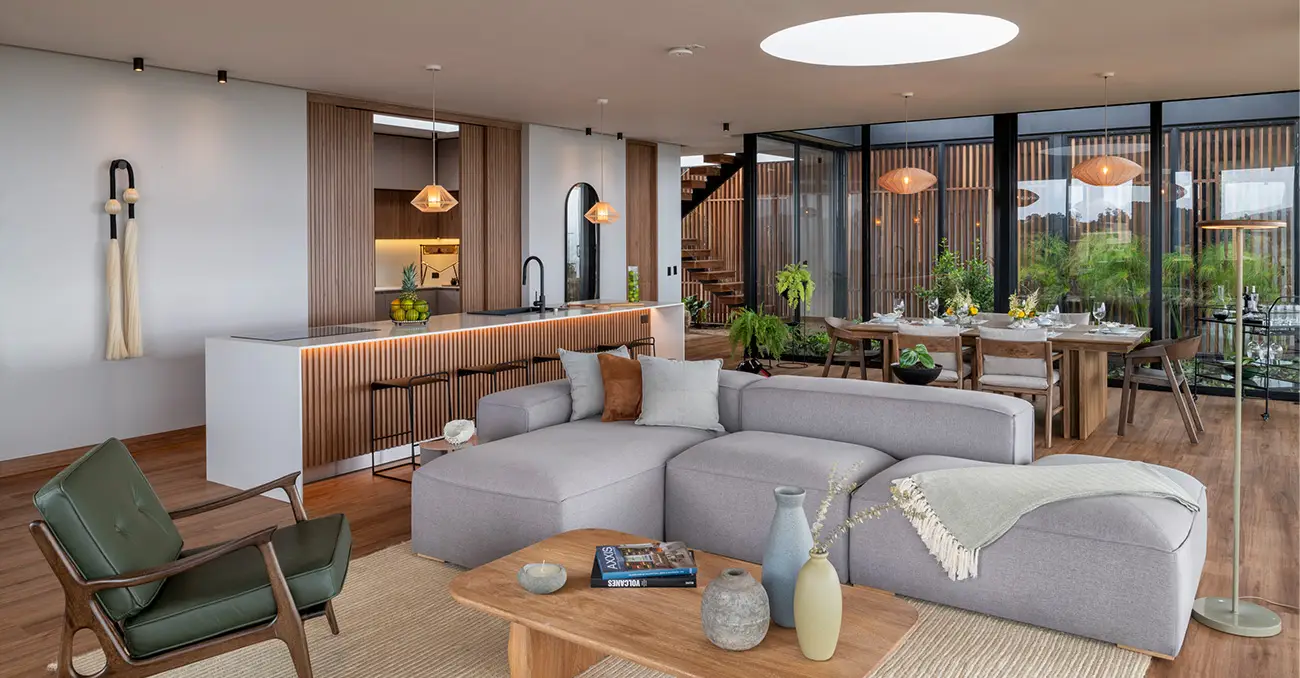

Choosing a lamp is more than an aesthetic decision. It is a choice that defines how a space is inhabited: how it is circulated, how it supports rest, and how it facilitates social interaction. Appropriate lighting supports the space, responds to its function, and contributes to the creation of atmosphere.
Before considering form, size, or materiality, it is essential to pause and ask a fundamental question:
How do I want this space to be inhabited?
Understanding use before the object
Every space has its own rhythm and therefore requires a specific lighting approach. A dining room, a bedroom, a reading corner, and a social living area are each illuminated differently. The appropriate lamp is one that responds to the actual use of the space, its scale, and the intended experience: calm, intimacy, focus, or gathering.
When lighting decisions are driven by use rather than by the object itself, the result is a space that is more coherent and more comfortable to inhabit.
Lighting for resting spaces
In bedrooms or areas intended for rest, light levels should be low, warm, and enveloping. Avoiding glare is essential, as is selecting luminaires that support a slower, quieter spatial rhythm.
Table lamps such as Barichara, Maicao, or Charalá are suitable for bedside tables or small shelving units. Their scale and handcrafted weaving softly diffuse the light, creating an intimate and serene atmosphere. In larger spaces, a floor lamp like Magdalena can introduce a vertical plane of light that adds depth and presence without overwhelming the environment.
Lighting for living and social spaces
Living rooms and social areas require more adaptable lighting conditions. These are spaces for conversation and shared activities, so lighting should balance visual presence with warmth.
Medium- to large-scale pendant lamps are particularly effective when positioned to complement both architectural elements and furniture. Designs such as Málaga, Nasaya, or Moebius provide visual character and diffused light that enhances spatial comfort. Installation height and proportion are critical: a well-positioned luminaire can function as the compositional focal point of the space.
Lighting for dining areas and central tables
In dining spaces, the lamp plays a central role. Beyond illumination, it defines the place of gathering. Light should be directed toward the table surface, reinforcing proximity and supporting shared activities.
Pieces such as Tatacoa, Nuquí, or Veracruz are well suited for dining tables or kitchen islands. Their form and woven structure establish a clear visual focus while warm light supports the experience without becoming intrusive. For long tables or commercial projects, the repetition of multiple pendants or the use of a Tubular fixture helps maintain rhythm, order, and visual coherence.
Lighting for transitional spaces and secondary areas
Hallways, entryways, studies, and reading corners are often secondary in the lighting plan, yet a considered lighting decision can significantly enhance them.
In these contexts, a smaller-scale fixture such as Guajira or Leticia, or a table lamp like Guadua or Magangué placed on a console or within a corner, can introduce identity and spatial depth. The objective is not to increase light levels, but to apply lighting with intention.
At Seese, each lamp is designed from an architectural perspective, understanding lighting as a way of inhabiting space. Choosing the appropriate luminaire transforms everyday experience and allows the space to express, with subtlety, its underlying intention.